.jpg)


May 11, 2026
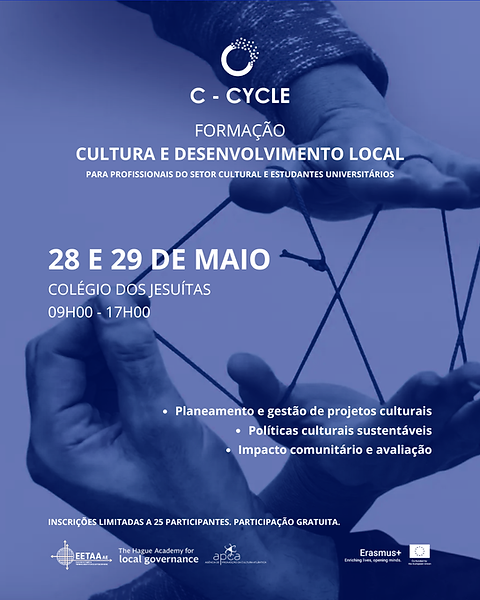
On 28 and 29 May 2026, Colégio dos Jesuítas will host the Culture and Local Development training programme as part of the European C-Cycle project – Cooperation on Cultural Yield through Coaching and Learning Evolution, funded by the Erasmus+ Programme.
The project is led by EETAA – Hellenic Agency for Local Development and Local Government, in partnership with APCA – Agência de Promoção da Cultura Atlântica and The Hague Academy for Local Governance, an internationally recognised institution with extensive experience in capacity building for policymakers and municipal professionals, with a particular focus on strategic planning, cultural governance and community impact.
C-Cycle brings together municipalities, cultural organisations, universities and creative-sector organisations from several European countries, with the aim of supporting cities in developing more sustainable, participatory cultural policies aligned with contemporary social and environmental challenges.
The international training programme, one of the key pillars of the project, begins in Madeira and aims to strengthen the skills of cultural-sector professionals and public-sector organisations, fostering international cooperation, networking and territorial innovation, with particular attention to island and peripheral contexts.
The training programme, delivered by The Hague Academy for Local Governance, focuses on the planning, implementation and evaluation of cultural projects with a tangible impact on local communities.
Throughout the training, participants will explore key issues related to the development of cultural policies and projects, including:
-
How to structure cultural projects aligned with municipal strategies
-
How to connect culture, sustainability and citizen engagement
-
How to define objectives, target audiences and impact indicators
-
How to turn cultural projects into instruments for local development
-
How to improve effectiveness in implementation, resource management and evaluation of results
The training combines essential theoretical content, the analysis of concrete European case studies and practical working sessions.
This approach enables participants to reflect directly on real projects developed by their municipalities and organisations, encouraging the practical application of the knowledge acquired during the training.
The training is aimed at:
-
Public-sector organisations
-
Cultural associations
-
University students in the cultural and creative fields, including Arts, Cultural Studies, Cultural Management, Communication, Culture and Organisations, and related areas
Participation is free of charge, and the training will be delivered in English.
The detailed programme will be announced shortly. The training will take place over two full days, from 9:30 am to 5:00 pm.